
Por Osvaldo
How to Detect AI-Generated Music: A Complete Technical Guide
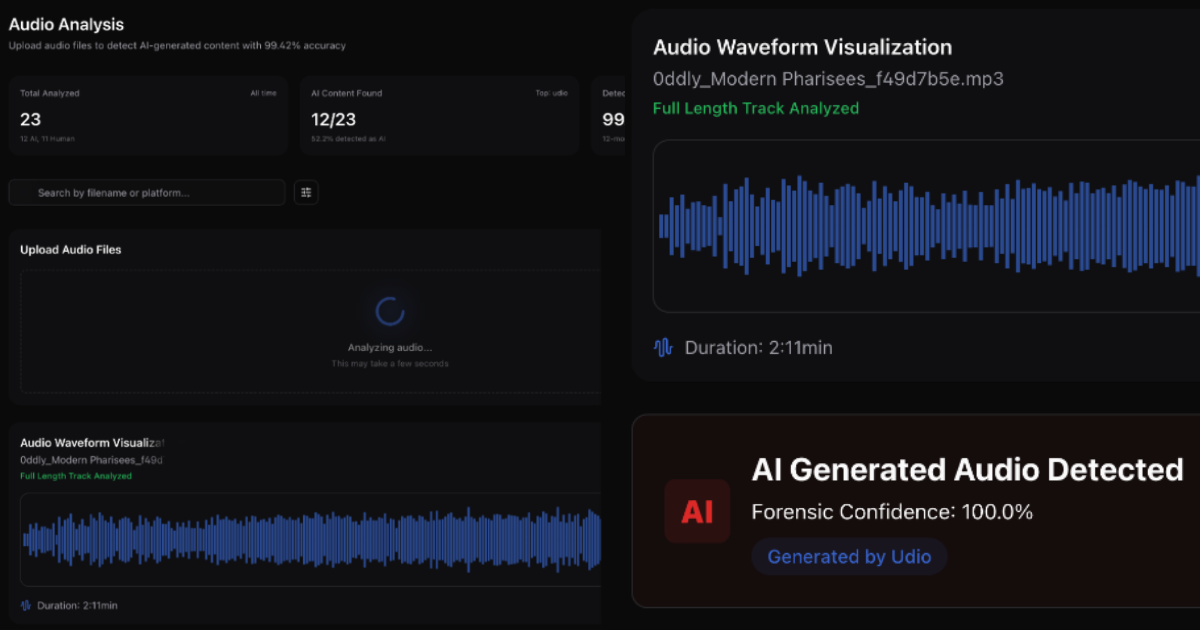
AI-generated music now accounts for approximately 39% of all daily uploads to streaming platforms. Deezer reports receiving roughly 60,000 fully AI-generated tracks every single day, and up to 85% of those streams were flagged as fraudulent in 2025. Meanwhile, a study found that 97% of listeners cannot distinguish AI-generated music from human-made recordings. For labels, distributors, publishers, and rights holders, the ability to detect AI-generated music is no longer optional. It is a technical and legal requirement. This guide explains the methods, tools, and science behind AI music detection in 2026.
Why Detecting AI Music Matters Now
Three forces are converging in 2026 that make AI music detection critical. First, the scale of the problem. Deezer's AI detection tool, in place since early 2025, has tagged 13.4 million AI-generated tracks on its platform. Billboard now uses Deezer's tool to determine which charting tracks are AI-generated, cross-referencing detection results with artist verification. Second, regulation. The EU AI Act's transparency requirements become enforceable on August 2, 2026. AI providers must embed machine-readable watermarks and metadata in generated content. Non-compliance carries fines of up to 15 million EUR or 3% of global annual turnover. Third, financial fraud. While AI tracks account for only about 3% of total streams on Deezer, 85% of those streams were identified as fraudulent, artificially inflated to generate royalty payouts at the expense of human artists.
How AI Music Detection Works: The Science
AI music detectors analyze audio across multiple dimensions simultaneously. Understanding these methods helps you evaluate which tools are reliable and why some detections fail.
Spectral Artifact Analysis
Every AI music generator leaves microscopic fingerprints in the frequency domain. Research published at ISMIR 2025 demonstrated that deconvolution layers, a core component of neural audio generators, produce systematic spectral peaks at predictable frequency intervals. These peaks are architecture-dependent, meaning they exist regardless of training data or learned weights. A simple logistic regression model with just 10,000 parameters achieved over 99% accuracy detecting these artifacts in both open-source models (DAC, Encodec, Musika) and commercial generators (Suno, Udio). In practical terms, AI generators like Suno and Udio leave behind a distinct spectral signature: a metallic high-frequency shimmer that marks the audio as synthetically generated.
Mel-Frequency Cepstral Coefficients (MFCCs)
MFCCs represent the spectral envelope of sound in a way that correlates with human perception of timbre and pitch. Detection systems extract MFCCs alongside Linear Frequency Cepstral Coefficients (LFCCs) and Constant-Q Cepstral Coefficients (CQCCs), processing each through separate neural network streams. AI-generated audio typically shows different MFCC distributions than human recordings, particularly in the higher coefficients that capture fine spectral detail.
Phase Coherence and Entropy
Human recordings have high phase entropy, meaning the phase relationships between frequency components are naturally chaotic. AI generators often produce audio with anomalously low phase entropy, creating impossibly perfect phase relationships that do not occur in real acoustic environments. Detection systems use the Hilbert Transform to extract instantaneous frequency and compute Shannon Entropy on phase information to flag these anomalies.
Temporal Quantization Detection
Human musicians, even in electronic music, introduce micro-timing variations in their performances. AI generators tend to snap transients to a mathematically perfect grid. Detection systems measure Inter-Beat Interval (IBI) variance: when the variance approaches zero, the likelihood of synthetic generation increases significantly. This applies to drums, vocal timing, and harmonic rhythm.
Cross-Correlation Analysis
Advanced detectors analyze the correlation between separated stems (vocals, drums, bass, instruments). In organic recordings, these elements interact dynamically. AI-generated tracks sometimes show either zero correlation between stems (disconnected generation) or hyper-lock, where stems are mathematically phase-locked in ways that are physically impossible in a real recording environment.
The Watermarking Layer: C2PA and SynthID
Detection is not limited to analyzing audio artifacts. Two complementary watermarking standards are emerging. C2PA (Coalition for Content Provenance and Authenticity) attaches cryptographically signed metadata to audio files, documenting authorship, source, licensing rights, and whether AI was involved in production. In 2026, C2PA compliance is becoming standard for publishers, sync licensors, and AI music providers. Google SynthID embeds imperceptible watermarks directly into audio waveforms generated by AI tools, including Google's Lyria music model. These watermarks survive compression, format conversion, and basic audio processing. The EU AI Act's Code of Practice on AI-generated content labeling, expected to be finalized by June 2026, proposes a multilayered approach combining both metadata embedding and imperceptible watermarking.
Known Limitations and Evasion Techniques
No detection system is perfect. Understanding the limitations helps set realistic expectations. Research from ISMIR found that simply resampling audio to 22.05 kHz caused one commercial detector to misclassify all Suno samples and most Udio samples. Detectors trained on one platform can struggle with others: models trained on Suno performed well on Udio (F1: 0.940-0.972), but models trained on Suno performed poorly when tested against Boomy (detection rates collapsed to 6-24%). A critical finding: some detectors identify production pipeline characteristics rather than genuine AI qualities. This means they can be fooled by post-processing the AI output through a standard DAW, applying effects, or re-recording through analog hardware. For this reason, enterprise-grade detection requires multi-model ensemble approaches that combine multiple detection methods simultaneously rather than relying on any single technique.
How to Evaluate an AI Music Detector
When choosing a detection tool for your catalog, ask these questions. Accuracy and false positive rate: a false positive means rejecting legitimate human-created music. For a label processing thousands of tracks, even a 1% false positive rate creates serious operational problems. Look for published accuracy metrics with specific false positive rates. Number of AI platforms detected: new generators appear regularly. A detector that only identifies Suno and Udio will miss tracks from MusicGen, ElevenLabs, Stable Audio, Riffusion, and newer platforms. Platform attribution: binary classification (AI or not) is useful, but knowing which specific generator was used provides stronger evidence for rights enforcement and fraud reporting. Processing speed: for catalog-scale operations, processing time matters. Some solutions handle individual tracks in seconds, while others can process hundreds of thousands of tracks per hour. Ensemble approach: single-model detectors are vulnerable to evasion. Multi-model ensemble systems that combine spectral analysis, temporal analysis, phase analysis, and watermark detection provide more robust results. API and integration: if you process catalogs programmatically, you need a REST API with SDKs, webhook support, and batch processing capabilities. Compliance: GDPR compliance is essential if you operate in or serve European markets. Check whether the service stores your audio files or processes them in real-time without retention.
Practical Steps for Labels and Distributors
If you are implementing AI detection in your workflow today, here is a practical approach. Step 1: Gate new deliveries. Integrate an AI detection API into your intake pipeline. Every new track should be scanned before it enters your catalog. Processing time of under 30 seconds per track allows this to happen without creating bottlenecks. Step 2: Audit your existing catalog. Run your full catalog through detection to identify AI content that may have entered before you had screening in place. Batch processing capabilities are essential here. Step 3: Establish a review threshold. Set confidence thresholds for automatic rejection, manual review, and automatic approval. Tracks with detection confidence above 95% can be flagged automatically. Tracks between 70-95% should go to manual review. Below 70% can pass through. Step 4: Document everything. Maintain an audit trail of all detection results. This documentation is critical for dispute resolution and compliance with emerging regulations. Step 5: Combine automated and human review. Use automated detection as a first pass, but have experienced A&R or quality control staff review flagged tracks. Automated systems catch what humans miss, and humans catch edge cases that confuse algorithms. Step 6: Stay current. AI music generation technology evolves rapidly. Ensure your detection provider updates their models regularly to keep pace with new generators and evasion techniques.
The Future of AI Music Detection
The detection landscape is evolving on multiple fronts. The EU AI Act will require AI providers to embed watermarks by August 2026, creating a regulatory backstop. C2PA and SynthID are establishing industry-wide provenance standards. Billboard's adoption of detection for chart verification signals mainstream acceptance. And the technical research continues to advance, with architecture-dependent artifacts providing a detection signal that cannot be eliminated without fundamentally changing how AI generates audio. For the music industry, the question is no longer whether to implement AI detection, but how quickly and at what scale.
AI music detectiondetect AI generated musicAI song checkerSuno detectorspectral analysisEU AI Act music